Acute Otitis Media in Children: Mechanism of Onset and Individualized Treatment Factoring in Family Wishes
Acute otitis media (middle ear infection) is one of the most common reasons why a child ends up visiting a doctor. By two years of age, approximately 70 percent of children have experienced it at least once.
The topic is important because research shows that many diagnoses are incorrect, leading to unnecessary antibiotic courses in children, which can have long-term effects on their health. Recommended treatment should also take individual preferences into account.
How a Middle Ear Infection Develops
A middle ear infection almost never appears without an exposure; it is most commonly the result of an upper respiratory tract infection. Additionally, allergies are a predisposing factor.
The middle ear is a cavity-like area between the eardrum and the Eustachian tube (image).
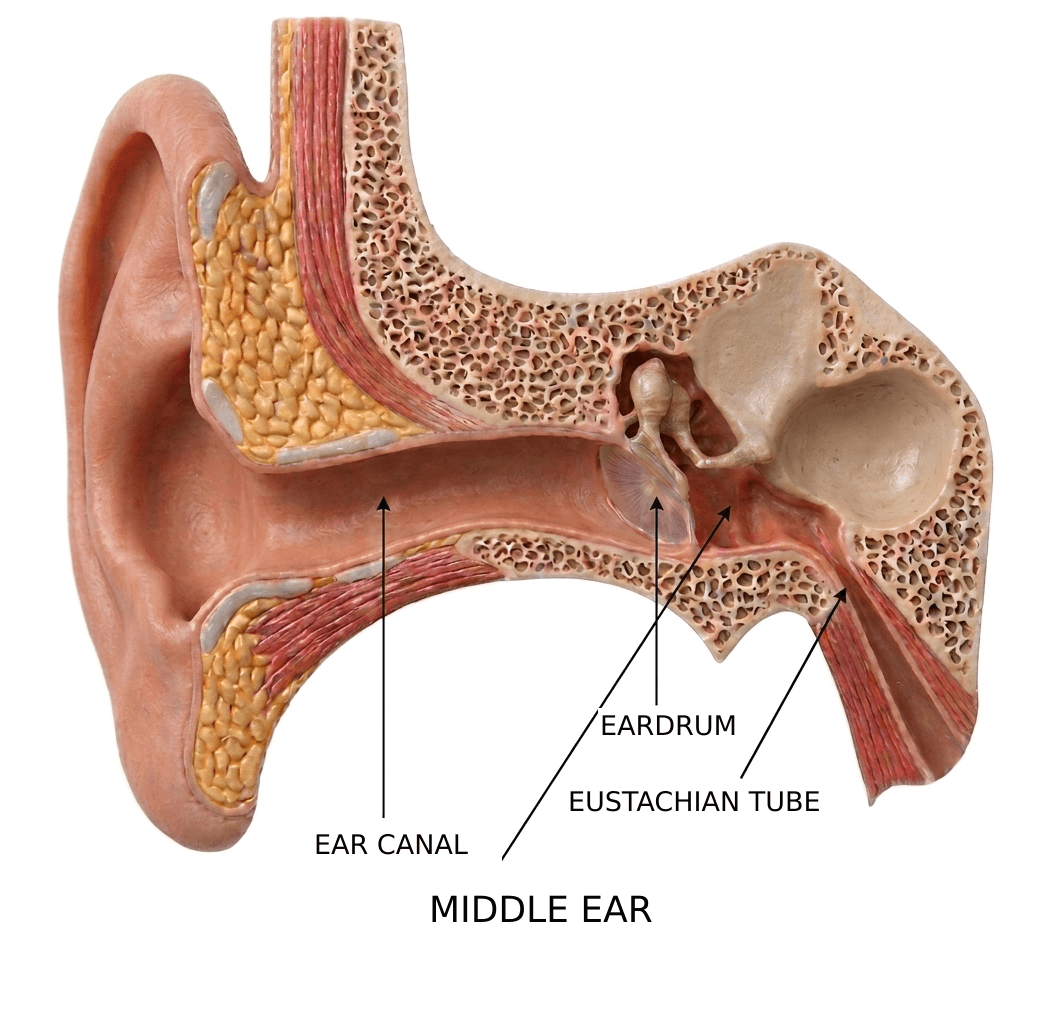
The process begins when a viral infection or an allergic reaction causes inflammation in the nasopharynx. The inflammation spreads from there to the Eustachian tube. A young child's Eustachian tube is shorter and more horizontal than an adult's, so even mild swelling of the mucous membrane blocks it. This causes the ear to feel clogged.
As a result of this blockage, negative pressure builds up in the middle ear, which can cause pain on its own. As the situation progresses, the negative pressure draws fluid secreted by tissues from the capillaries of the mucous membrane into the middle ear cavity. At this stage, it is not yet an antibiotic-treatable middle ear infection, and the chain of events can resolve on its own at any time as the swelling in the Eustachian tube subsides. However, if the inflammatory state progresses, bacteria turn the fluid into an infection, resulting in acute otitis media. This usually triggers a fever in the child and causes more severe ear pain.
Diagnostics and Challenges
Diagnosing a middle ear infection is not easy. Sometimes it is difficult to see into the ear due to individual anatomy, but there are also frequently challenges in interpreting the findings.
Crying, fever, and a recent upper respiratory tract infection all cause redness of the eardrum, which on its own might be misinterpreted as a middle ear infection. However, a reliable diagnosis of otitis media requires evidence of infected middle ear fluid. This is indicated by either a bulging or yellowish-cloudy eardrum and the loss of the light reflex, as well as reduced eardrum mobility detected via pneumatic otoscopy or tympanometry, alongside symptoms consistent with an infection.
Treatment in Finland
Pain Management is the Foundation of Care
A child with a middle ear infection experiences genuine pain, and assessing pain in a young child is difficult. The recommended dosing for pain relievers is:
- Paracetamol starting from newborn age
- Additionally, ibuprofen from 3 months of age, or naproxen from 12 months of age (NSAIDs)
- If needed, numbing ear drops (cinchocaine) as long as the eardrum is intact
Paracetamol and an NSAID can be combined, and for moderate to severe pain, this combination is more effective than either medication used alone.
The Decision for Antibiotic Treatment
Most middle ear infections resolve without antibiotics. A Finnish placebo-controlled study by Tähtinen and colleagues (NEJM 2011) showed that immediate amoxicillin-clavulanic acid treatment reduces treatment failure compared to a placebo, but the absolute benefit is small and the NNT (number needed to treat) is significant. Antibiotics shorten the duration of fever and ear pain by about one day. Antibiotics also reduce the risk of complications, though the risk of complications is low in any case.
Antibiotics should be started when:
- The eardrum has ruptured spontaneously (in which case a bacterial culture sample is taken from the discharge to refine treatment)
- The eardrum is bulging severely
- The child has systemic symptoms, is very young, or has a significant underlying medical condition
If these conditions are not met, and especially if the eardrum finding is ambiguous, monitoring is justified, and starting antibiotics should generally be questioned.
Choice of Medication and Duration of Treatment
When an antibiotic is indicated, the primary choice is amoxicillin or amoxicillin-clavulanic acid, both divided into two daily doses. Amoxicillin-clavulanic acid is also effective against beta-lactamase-producing M. catarrhalis strains and some H. influenzae strains, but it also carries more side effects. For the most part, amoxicillin is preferable in typical cases. The usual duration of the course is 5 to 7 days.
Monitoring and Referral to Specialized Care
Middle ear fluid can persist for weeks after a cured middle ear infection, and fluid alone without symptoms is normal. A follow-up check in 1 to 2 months is justified if the child has recurrent middle ear infections, an infant under 1 year of age has had a bilateral middle ear infection, speech development is significantly delayed, or there is a known hearing impairment. A referral for ear tube consideration should be made when middle ear infections recur frequently within a short period of time.
Considering Family Wishes in Treatment
Current treatment guidelines emphasize shared decision-making, meaning that the family's situation and wishes are taken into account during care. Starting an antibiotic, monitoring symptoms, referring to specialized care — all decisions can be adapted based on the family's priorities. I highly recommend that families learn more about the effects, benefits, and harms of antibiotic treatments to ensure informed decision-making.
References
Tähtinen PA, Laine MK, Huovinen P, Jalava J, Ruuskanen O, Ruohola A. A placebo-controlled trial of antimicrobial treatment for acute otitis media. N Engl J Med 2011;364:116–126.
Tähtinen PA, Nokso-Koivisto J. Lapsen äkillisen välikorvatulehduksen hoito, seuranta ja ehkäisy. Lääkärin käsikirja, Duodecim, updated March 27, 2024.